
Article: Why Perfectly Round Isn’t Always Better: My Love of Baroque Pearls

Why Perfectly Round Isn’t Always Better: My Love of Baroque Pearls
There is something undeniably beautiful about a perfectly round pearl. It’s classic, elegant, balanced—and sometimes exactly what a piece of jewelry needs. But give me a tray of perfectly matched round pearls next to a collection of beautifully irregular baroque ones and chances are my eyes will start wandering toward the odd shapes.
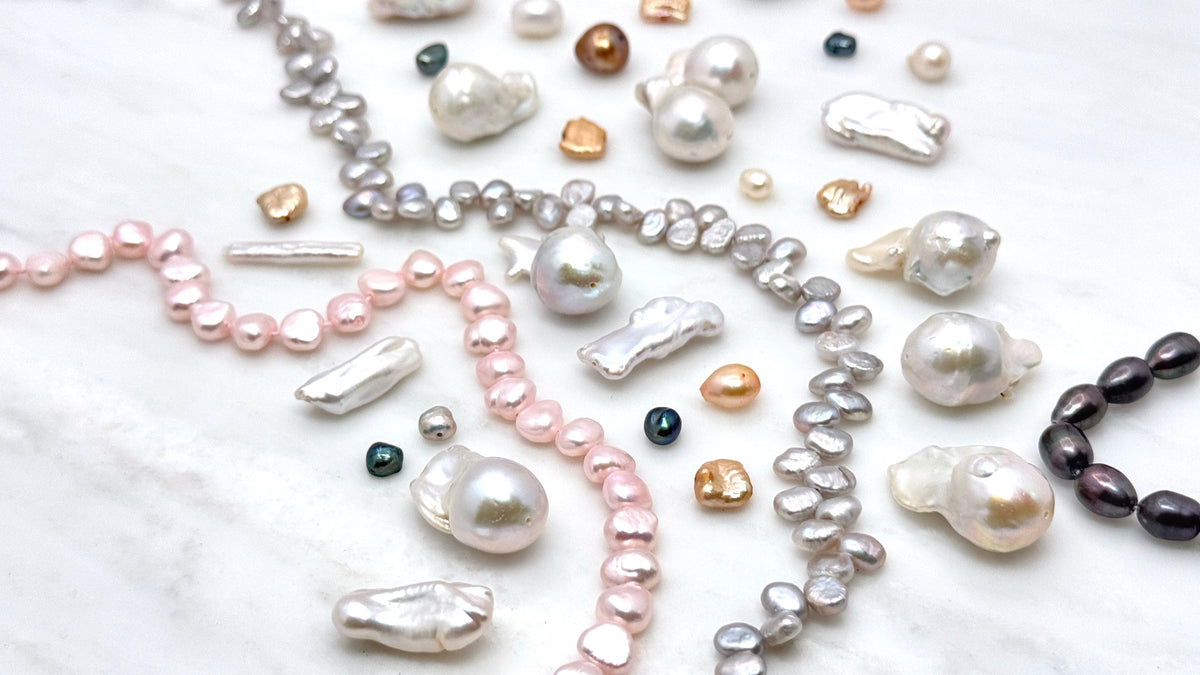
A pearl with an unexpected curve. A long teardrop. A little ridge that catches the light differently. A shape that looks sculpted – only nature did the sculpting.
Those are often the pearls I want to pick up first and I get so excited to create with.

I like pearls with personality
I have always been drawn to materials that have some individuality, and baroque pearls certainly have no shortage of that. Unlike perfectly round pearls, baroque pearls grow into irregular, free-form shapes, which means you can look through an entire strand—or an entire parcel—and keep discovering something different.
Some are softly asymmetrical. Others are dramatically elongated, flattened, rippled, or visibly architectural. Over the years I have collected freshwater pearls shaped like large teardrops, flame balls, elongated drops, rectangles, sticks, and wonderfully strange forms that don't fit neatly into any one description. I also like to work with Keshi pearls, which have their own irresistible free-form shapes and beautiful nacre.

Time and time again, I find myself turning these pearls over in my hand, looking at them from different directions and noticing how much the character can change depending on the angle. Finding and lingering over the unexpected, unmatched, singular element is part of the fun for me.
Sometimes the “imperfect” pearl is the perfect one
When I choose pearls for a design, I am not necessarily searching for the pearl with the most perfect shape. I'm looking for the one that makes me stop.
It might have an especially beautiful luster. Or perhaps an unusual silhouette. Or maybe one side has an interesting curve that would look wonderful hanging from an earring, or its slightly twisted shape suggests that it should become the focal point of a necklace rather than simply one element among many.
Sometimes a technically more uniform pearl is not nearly as interesting to me as the slightly strange one sitting beside it.
I think this is one of the reasons I enjoy designing with natural materials so much. Instead of asking every stone or pearl to conform to an idea I already have, I can let the material participate in the design. An unusual pearl may change the direction of a piece entirely. And believe me, this happens quite a bit...
There is a little bit of discovery involved—and I love that.
Freshwater baroque pearls fascinate me in a different way because of the incredible range of shapes, sizes, and personalities available. Some are soft and delicate; others are large and sculptural. Some look wonderfully organic and imperfect, with playful asymmetries, dents, and irregularities, while others have such strong silhouettes that they almost become tiny design objects on their own.
And Tahitian pearls? They’re in a league of their own.
Baroque Tahitian pearls may be some of the hardest for me to resist.

Their shapes alone can be spectacular. I have seen, admired, touched, and collected some beautifully irregular or asymmetrical Tahitian pearls, including elongated teardrops and other wonderfully organic forms that make me wonder how nature came up with them.
As for the color, gray is almost too simple a word for them. Depending on the pearl and the light, I can see silvery gray, charcoal, green, blue, soft violet, peacock-like flashes, and other subtle shifts across the surface. Turn the pearl slightly, and suddenly something appears that you didn't notice a second earlier.
I can spend an insane amount of time looking at a beautiful Tahitian pearl from different angles. Throw the quirky, irregular, or asymmetrical shape of a baroque pearl into the mix and I won’t get tired of contemplating the unmatched allure of these wonderful artefacts shaped in warm, shallow waters. And honestly, I think that's part of what a special material should do: it should make you want to look twice, or three times, or five times, or… for a long time.

Designing around what nature already created
There isn't one type of baroque pearl that I love the most. I love the variety.
When I work with an especially interesting pearl, I usually don't want to overpower it.
Sometimes the best design decision is to give it some room.
A beautiful baroque pearl may need only a simple chain, a carefully chosen gemstone, an understated pearl to counterbalance it, a hand-forged piece of metal to frame it, or a few small fused details around it. Other times I like pairing pearls with turquoise or another natural gemstone because the differences in color and texture make both materials more interesting.

What I don't want to do is force every pearl into looking identical to the next one.

That philosophy is very much part of The Happy Gems. I love beautiful materials, but I also love evidence of nature and of the hand that made the piece. Slight differences, interesting textures, unusual stones, asymmetry, hand-worked metal—those things give jewelry personality.
To me, handmade jewelry doesn't have to look as though it came off an assembly line to feel refined.
Quite the opposite.

A different kind of elegance
Pearls are sometimes associated with a very traditional kind of jewelry: perfectly matched, perfectly round, and saved for occasions when you want to look especially polished. But I love seeing them worn in a much less traditional way, too – mixed into everyday outfits, layered with other jewelry, or worn simply.
A wonderfully irregular pearl can feel modern, relaxed, artistic, even a little playful. Put it on a fine gold-filled chain and it can feel understated. Pair it with turquoise and suddenly it feels quite offbeat, intriguing, and beautiful. Let a large baroque pearl stand almost on its own and it becomes a sculptural stunner.

That versatility is one of the reasons I keep stocking up on different types of baroque pearls every season—and why I keep finding new reasons to create with them.
And perhaps that is ultimately what I love most about baroque pearls: they remind me that beauty doesn't always come from perfect symmetry.
Sometimes it is the unexpected curve, the uneven surface, the unusual silhouette—or that one pearl in the entire group that refuses to look like the others—that makes a piece memorable.
And very often, that's the one I would pick for my next piece.
Featured Baroque Pearl Jewelry
Explore Pearls
- Browse all freshwater pearl pieces in Forever Pearls
- Browse all Tahitian pearl pieces in Tahitian Glow