Article: How to Mix Gold and Silver Jewelry Without Overthinking It

How to Mix Gold and Silver Jewelry Without Overthinking It
For a long time, mixing gold and silver jewelry came with an unnecessary amount of anxiety. If you wore a silver necklace, were your earrings supposed to be silver too? And what about your rings or your watch? And the tiny gold clasp no one was going to notice anyway?
I have never been particularly interested in jewelry rules that make getting dressed more complicated.
Gold and silver can look beautiful together. In fact, sometimes the contrast between warm gold and cool silver makes an outfit—and the jewelry itself—more interesting than perfectly matching everything ever could.
The point, if there is one, is not to make it look as though you tried too hard.
Start with the pieces you actually want to wear

I think this is where people can overthink mixed metals before they even begin.
Instead of deciding, Today I am going to create a mixed-metal look, I would start with the piece you genuinely feel like wearing. Maybe it is a sterling silver pendant. Maybe it is a fine gold-filled chain you almost never take off. Maybe it is a favorite pair of silver earrings.
Then build around that.
If the next piece you reach for happens to be the other metal, try it on before deciding that it “doesn’t match.” Very often, it does.
Jewelry tends to feel more natural when it looks collected rather than coordinated within an inch of its life.
And personally, I think a little visual tension is a good thing.
You don't need everything to be fifty-fifty

Mixing metals doesn't mean you need an equal amount of gold and silver.
A mostly silver look with one delicate gold element can be beautiful. So can several fine gold chains with one substantial sterling silver pendant. The contrast is sometimes more interesting when one metal clearly takes the lead and the other simply shows up.
Think less about making the metals equal and more about whether the overall composition feels balanced.
Scale matters here, too.
A bold hammered silver cuff may look wonderful beside one or two finer gold-filled bracelets. A substantial silver ring doesn't necessarily need another equally substantial gold ring to “balance” it. Sometimes the contrast between something strong and sculptural and something very fine is exactly what makes the combination work.
There is no jewelry accounting system. You don't have to settle the score.
Let pearls and gemstones do some of the connecting
One of my favorite ways to mix metals is to let another material sit between them visually.

Pearls are especially good at this.
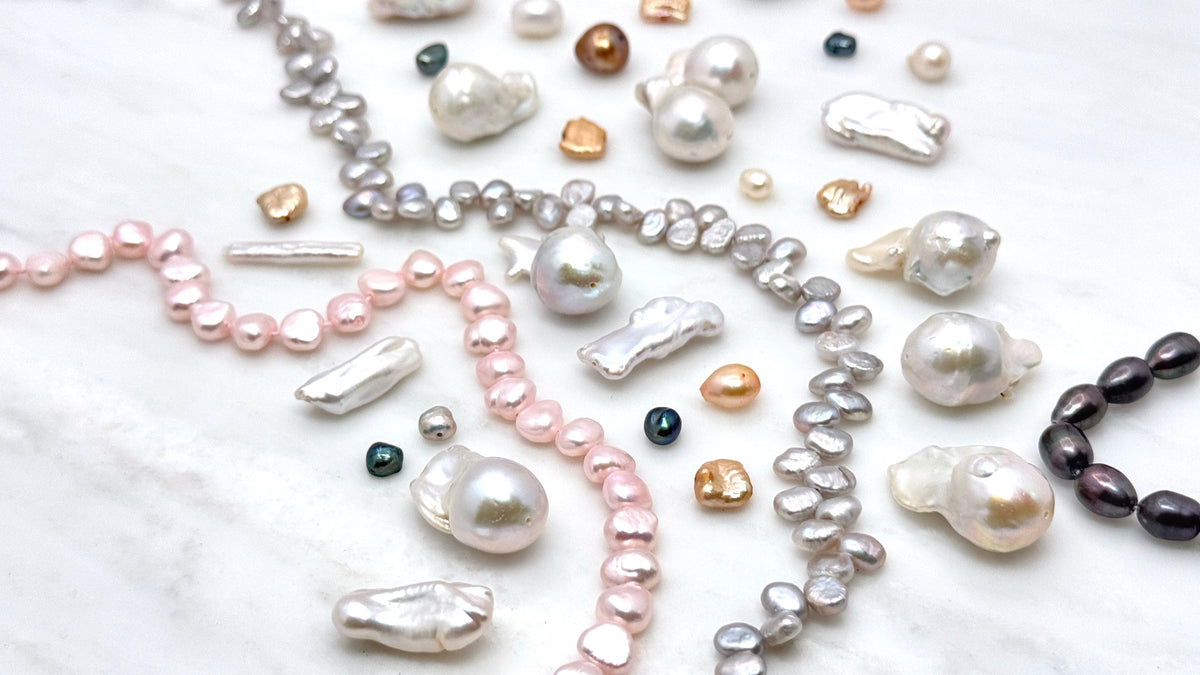
A luminous white pearl doesn't belong exclusively to either gold or silver, so it can make the transition between the two feel effortless. A pearl necklace layered with a fine gold-filled chain and a sterling silver pendant can suddenly make the whole mix feel intentional without being obvious about it.
The same thing can happen with gemstones.
Turquoise is one of my favorites because it has such a strong identity of its own. Pair turquoise with silver and it can feel earthy, cool, and a little Southwestern. Add a touch of gold and the same stone can suddenly feel warmer and more unexpected.
Other stones can do the same thing. Instead of asking whether the metals match, your eye starts noticing the color, texture, and shape connecting the pieces.
And I find that much more interesting.
Texture can matter more than color

As a metalsmith, this is probably the part I notice most.
Two pieces can be made from the same metal and still feel completely unrelated if their surfaces, scale, and character are very different. On the other hand, a textured sterling silver piece and a warm gold element can work beautifully together because they share something else—a handmade quality, an organic surface, a similar weight, or simply the same mood.
A hammered surface catches light differently from a high polish. Reticulated silver has its own wonderful topography. Fused details, irregular edges, hand-forged shapes—all of these affect how a piece reads before you even get to the question of whether it is silver or gold.
That is one reason I don't think metal color needs to be the first thing you match.
Sometimes texture is doing much more of the work.
Layering makes mixed metals especially easy
Necklaces are probably one of the easiest ways to experiment.
If you already wear a fine gold chain, add a slightly longer silver necklace and see what happens. Or do the reverse. One can be extremely simple while the other carries the focal point.
I like variation in chain styles, too. A delicate chain beside a small paperclip chain or something slightly more substantial keeps the layers from looking overly planned.
The same idea works with bracelets.
A silver cuff doesn't have to live in a silver-only world. Put a slim gold-filled bracelet beside it, add something with pearls or gemstones, and suddenly the stack has more depth.
I wouldn't worry about creating perfect intervals between every piece, either. Jewelry usually looks more relaxed when it is allowed to move.

Sometimes one tiny detail is enough
You don't even need to commit to an obvious mixed-metal look.
Maybe your necklace is silver and your earrings have a small gold detail. Maybe you are wearing mostly gold but add one silver ring. Maybe a sterling silver pendant sits on a gold-filled chain.
That little interruption can be enough.
In fact, I sometimes prefer that to a very deliberate half-gold, half-silver combination. It feels less styled in the traditional sense and more like the jewelry simply belongs to the person wearing it and there is something appealing about that lack of fuss.
Matching isn't the same thing as harmony
I think this is ultimately the distinction that matters.
Jewelry does not have to match perfectly to look harmonious.
The pieces might relate through shape, texture, scale, gemstones, pearls, or even just the way they feel together. Warm and cool metals can create contrast without creating conflict.
And if something feels slightly unexpected, even better.
I like jewelry that has some personality. I like combinations that make you look twice. I like a polished element next to something textured, an organic pearl beside a geometric chain, warm gold beside cool silver.
The combination doesn't have to obey a formula to look intentional.
Wear the combination, not the rule
If you put on gold and silver together and like what you see, I think that is already a very good reason to wear them.
You can always make small adjustments—remove one piece, change the scale, add a pearl, switch the necklace length—but I wouldn't start from the assumption that mixing metals is something you need to “get right.”
Jewelry should be one of the enjoyable parts of getting dressed.
So mix the metals. Add the odd piece. Let one necklace be gold and the other silver. Put the fine bracelet next to the heavy cuff.
And if it feels a little unexpected, that may be exactly why it works.
Featured Jewelry for Mixing Metals
Explore the Everyday Minimal Collection
Find silver and gold pieces that make mixed-metal styling easy